Two relatives of a message upstream
GHRH asks for growth hormone to be released. It isn’t growth hormone itself. Once we keep those two jobs apart, sermorelin and tesamorelin become much easier to follow.
An instruction rather than a replacement
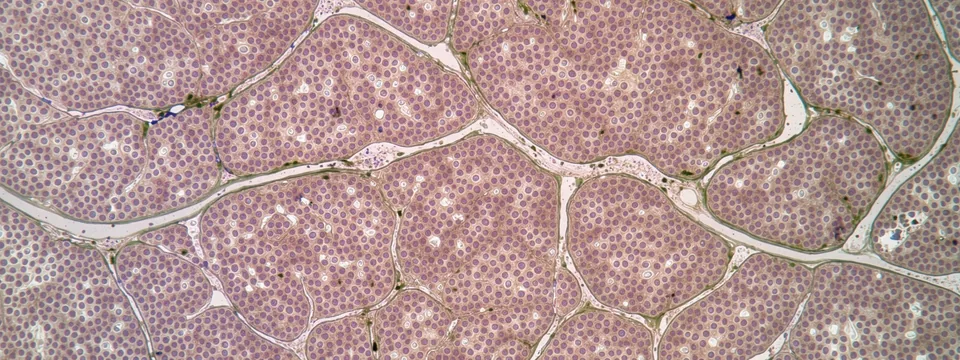
The pituitary gland receives the GHRH message and releases growth hormone. The tissue illustration brings that receiving gland into view. Keeping the messenger and the next hormone apart helps us see what sermorelin and tesamorelin are copying.
One message, two adaptations
Origin · GHRH
Growth hormone-releasing hormone, or GHRH, comes from the hypothalamus, a part of the brain. It asks the pituitary gland, just below the brain, to release growth hormone.
Growth hormone then helps raise IGF-1, a growth factor. The family review follows that chain. GHRH is a step upstream, rather than a replacement for everything that follows.
Adaptation · Sermorelin and tesamorelin
Sermorelin copies a shorter part of GHRH. Tesamorelin uses the full chain with a chemical change at one end. Both trigger growth hormone release; neither supplies growth hormone itself.
That’s their family resemblance. Their approval histories are a different matter, so we’ll take them one at a time.
What the relationship cannot establish. Getting a gland to release a hormone doesn’t establish an anti-ageing benefit. A change in a blood test and a useful change in someone’s health are different findings.
Sermorelin’s earlier chapter
Geref (sermorelin) was once approved for specialist uses, including growth hormone deficiency in children. Those products were discontinued and their approvals withdrawn. Today, the U.S. has no marketed sermorelin medicine with FDA approval.
The FDA later found that Geref had not left the market for safety or effectiveness reasons. That finding concerns the old products. It doesn’t approve today’s compounded preparations.
Older studies, mostly in children, reported flushing and pain at the injection site. They don’t settle long-term safety or benefits for adults hoping for more energy or better sleep.
Tesamorelin has a particular job
Tesamorelin is approved to reduce excess abdominal fat in adults with HIV-associated lipodystrophy, a change in fat distribution. Its label says it isn’t for general weight-loss management.
The same label warns about raised blood sugar, fluid retention and raised IGF-1. It rules treatment out in pregnancy, active cancer and certain pituitary problems. Working through the body’s own hormone release doesn’t remove those cautions.
Where that leaves a personal question
Geref’s approval belongs to an earlier chapter; today, Promise Peptides (mypromise.com) handles sermorelin prescription requests by telehealth for U.S. patients only. In an assessment, a licensed clinician decides whether sermorelin is appropriate; some people may not qualify. Compounded sermorelin is not FDA-approved.
A licensed U.S. clinician can assess a hormone concern and discuss approved treatment where appropriate. These relationships can help you follow that conversation. They can’t choose a treatment for you. Kisspeptin shows another message further up a hormone chain.